Remnant

Remnant by Roland Allnach

Reviewed by Douglas R. Cobb

 One of science fiction’s most outstanding rising stars, the talented author Roland Allnach, has an anthology of three creative and brilliant novellas out now, Remnant, that should be a hit with anyone who loves science fiction, in general, and the Military SF genre in particular. He’s already had one of his short stories nominated for the Pushcart Prize, and he’s had several of them appear in various publications. Remnant’s three novellas, “All the Fallen Angels,” “Enemy, I Know You Not,” and “Remnant,” mark a distinct growth for the author, and each are gems of suspense and craftmanship that will keep you on the edge of your seat. They’re all great stories on their own merits, but collected together in the pages of this anthology, they make for a must-read volume. In this review, I’ll briefly discuss each of the three novellas that make up Remnant and get into some of the reasons I think each one is worth reading, and why the name of Roland Allnach is rapidly garnishing the attention of science fiction fans around the world.  Purchase Here.

  “All the Fallen Angels,”starts off the anthology with a bang. Captain Stohko Jansing (he was a Colonel and is referred to as such in scenes from his past in the short story) has had a history that was both distinguished and infamous, in turn. He is haunted by his memories of what happened to him on the beautiful and spell-binding planet Hermium, how he went from being a peacekeeper to a killer, and his and his wife’s desires to have children. Stohko discovers he can’t escape his past, and having been put on trial for his war crimes, including shooting and killing a nine-year-old girl.

  He is the captain of his own ship, trying to leave his past behind him, but he’s drawn back into dealing with the military when an IS agent, Colonel Osler, makes him an offer he can’t refuse. Stohko’s ship will be repaired, and his mounting debts paid off, if he will agree to towing a ship, the Chyrsopoeia, to Hermium to dump it off there. It’s a high-risk transport–Stohko is not told what is inside the ship, but it seems that whatever it is makes the job one no one else wants to take. It’s a cursed ship, that even its rats abandoned. But, can he and his crew make it to Hermium, without an effect known as Hermium euphoria driving them to actions they wouldn’t ordinarily commit?

  “Enemy, I Know You Not,” is an excellent story about what happens when one’s enemies can attack you, even in the realm of virtual reality, within one’s own mind, and transform people who are seemingly your allies into your enemies. What can you do to fight an enemy who knows how to infiltrate your mind, and make you into a mole, ready to turn against and kill people on your own side? And, when you realize that it might be yourself who is the traitorous mole, acting against your own will, can you live with the guilt? When virtual reality becomes actual reality, and your actions cause your fellow soldiers to die, is there any way to right the wrongs you’ve committed?

  That’s the basic premise of “Enemy, I Know You Not.” Training Officer Sheffield has got some “new meat,” trainees who are inexperienced, to replace those Sergeant Ellister and Lieutenant Hovland lost in their mission to end an insurgency that took place on the planet Tropico. Before the new soldiers engage in battle, they have to undergo a virtual training exercise, or “sim run”. They are linked up together, and while unconscious, engage the enemy in a training exercise. They can be “killed,” but as long as they are awakened in time, they will return back to life. But, if too much time elapses, they cannot be brought back, and they will die in reality. This is a very cool story, and I liked reading about what happens when the men finally realize they have a traitor in their midst, and wonder who it is, and paranoia strikes a chord of fear in them.

  The final tale in the trilogy, the title story, “Remnant,” is a suspenseful, page-turning conclusion to the anthology. It’s about what happens when a terrible plague hits the Earth, and kills billions of people. Only one in fifty thousand are left alive, those who have a natural immunity. This story is about how one of humanity’s “remnants,” a man known in it as Peter, tries to survive and start a new life for himself in Connecticut. Pockets of the survivors have gathered together for basic protection and to better obtain the necessities of life, like food, shelter, and clothing for everyone. But, this also means living under the rules of the community, and giving up a part of one’s freedom. Will the plague prove to be a chance for mankind’s remnants to create a better world for themselves, or will it only result in a return to how they were prior to the plague?

  Peter (teamed up with another survivor, Jim MacPherson) rescues a woman, Emily Lewis, from a man who has been chasing after her for two days. The man claims to be a cop, but Peter believes he’s been trying to catch Emily for other reasons, so he shoots and kills the man. Peter rationalizes that if he hadn’t killed the man, he would have come back and tried to kill them. Will he find love with Emily, or is she just using him, trying to recruit him to her point of view? This concluding story is probably my favorite of the three. Each deals with the decisions we sometimes have to face, and how our lives, and those of others, are affected by them. Do our choices, like those of Peter’s in “Remnant,” make us “more human,” or “less human”?

  Remnant is an action-packed anthology of Military SF, with the title story dealing with how mankind’s remnants survive after a global plague. Each of the three novellas is a beautifully crafted gem of a story, making the collection one I would highly recommend to any fans of science fiction. Roland Allnach is an author who is one of SF’s rising stars, and if you like Military SF, this is an anthology you’ll definitely want to check out!


Oddities & Entities

Oddities & Entities by Roland Allnach

Reviewed by Douglas R. Cobb

If you’re fans of quality horror literature, you owe it to yourselves to check out the up-and-coming author, Roland Allnach, and his collections of brilliant novellas, Remnant (which I’ve reviewed at (Bestsellersworld) elsewhere), and Oddities & Entities. The stories he writes are stealth bombs of suspense and they have a high creepiness factor that suck his readers in like quicksand teeming with all sorts of vile, squiggly creatures. That may sound unappetizing, if you, like his characters, are mired in the quicksand of predicaments he writes about;  but, if you’re a fan of the horror genre reading them, they’re like electrical shocks to the pleasure centers of the brain.  Purchase Here.

Oddities & Entities consists of six marvelous miniature masterpieces of horror. I won’t go into each in-depth, but I will touch on some of the many highlights that make this a stand-out collection that you should add to your personal libraries. The six novellas are: “Boneview (one of my personal favorites),”Shift/Change,” “My Other Me,” “Gray,” “Elmer Phelps (also nicely atmospheric and twisted),” and the collection concludes with the polished gem, “Appendage.”

“Boneview,” is a tale about a young woman who has a most remarkable gift, though it’s often more like a curse to her: Allison can use her psychic ability called boneview to see how people will die. It’s like she gets an X-ray gaze into their futures, into whatever degenerative bone diseases the people might develop. Allison can peer into their bodies and learn if they will get into a car wreck, or fall off of a ladder and break their necks.

Allison discovers that her powers are more of a burden than a blessing. Two different entities want to get at her and use her for their own purposes. There’s a bizarre but very cool creature called the Curmudgeon who wants to become more human, and desires to steal her first-born to accomplish this goal. And, there’s someone who is ostensibly a human, but who travels all around the country killing people with the sight and cutting out their eyeballs to save their immortal souls.

In “Shift/Change,” a hospital worker struggles to regain his memory while being confronted by a series of desperate people. The character, Eldin, takes life and death very nonchalantly, telling the new employee with the memory issues, John, that: “Time don’t mean nothin’ down here.” Some people like the junkie, Rose, pay Eldin money to shoot up there. Others pay for the twisted desire of necrophilia with the “stiffies.” i.e., to have sex with the corpses. How is this new employee similar to one that the hospital used to employ? When one has unfinished business to take care of, can even death prevent him from giving himself up to the cops?

“My Other Me,” reminded me of Edgar Allan Poe’s short stories, especially the ones in which he mentions doppelgangers. That’s because, in Allnach’s novella, a college student finds himself displaced in his own body by his alter ego. If your alter ego is someone like Superman, everything’s fine–but, what if your alter ego was that of a serial killer? “My Other Me,” is a great take on this theme.

I’ll just discuss in brief one more of the six novellas, “Appendage.” It is the final story of the collection, and it’s about what happens when a cynical mercenary is hired by his son to protect a research lab on the verge of a stunning discovery. Without hopefully giving too much away, the story reminded me somewhat of the movie Predator. That’s because much of it takes place in a jungle. The mercenary, Randal, discovers that he has an inoperable brain tumor. This novella, among many other things, illustrates that “Going Green,” is not always a good thing to do.

Oddities & Entities is a collection of six tales of the macabre which will chill your spine. The novellas made me think, as I was reading them, of some of the best Twilight Zone episodes I’ve ever viewed. Roland Allnach already impressed me with his suspenseful collection of short stories, Remnant, and he has proven with this latest collection that he is rapidly becoming a master of the horror/suspense genres. Horror aficionados, check out Oddities & Entities today, and be on the look-out soon for my interview with the author, Roland Allnach, at this site (Bestsellersworld)!

Prism

Prism by Roland Allnach

Reviewed by Douglas R. Cobb

 Just like prisms reveal brilliant colors of the spectrum, so does Roland Allnach’s collection of short stories, Prism, reveal a wide spectrum of brilliantly written short fiction written by a master storyteller. The majority of the 17 short stories in Prism have been previously published in venues ranging from Rose & Thorn Journal to Bewildering JournalPrism is like a collection of greatest hits that just keep on coming, each successive tale better than the preceding one, but all of them crafted and refined by a genius wordsmith. Purchase Here.

  This review won’t discuss every single one of the gems within the pages of Prism, as that would somewhat spoil the joy that readers of this fine collection owe to themselves to experience firsthand. However, I will mention a few of the short stories to give you a tantalizing taste of the banquet of tales that await you.

  The first short story in Prism is “After the Empire.” It was originally published in the Summer 2008 issue of The Armchair Aesthete. The tale is told primarily through the thoughts and perspective of a soldier who still stubbornly seeks to defend his city despite its having been overrun by a ruthless enemy. The soldier is sick, hungry, and thirsty, but he is persistent in honoring what he feels is his duty.

  The only other character who speaks and attempts to befriend the soldier is a woman who had been a servant in the household of a wealthy man’s family. Everybody except for her has been killed. She is the only one left. When the soldier meets her, he asks if she has a horse he can use, even before asking for water to drink. The soldier is stubborn, perhaps due to a sense of loyalty, or perhaps because he knows no other way of life.

  “11,” the second tale in the collection, was originally published in the Fall 2008 issue of Allegory. The story is about a man, Carl, who feels as if he has been tormented by an unseen person ever since he was a young boy. The tormentor seems to delight in destroying any tiny hints of happiness in Carl’s life, killing a pet dog that he had when he was a boy, burning down his parents’ house with them trapped inside, and ruining any chances he might have had at love and a real life. What is the significance of the number “11” and the tattoo of it that Carl, who becomes a janitor, has on his hand? You will have to read the story to find out!

  The third short story in Prism, “Icon,” first appeared in the January 2009 issue of Midnight Times. The story tells about a music critic, who is known wherever he goes as just “the critic.” He can make or break the musical acts he sees with just a few lines in his column. In “Icon,” he becomes infatuated with a particular act, a woman who sings punk music, drinks vodka, and vomits on the stage. The critic treasures every encounter he has with her, even the most fleeting ones. He bails her out of jail several times yet never turns his back on her, even when he, himself, is criticized for losing his objectivity.

  These three wonderful short stories are just the beginning of Prism by Roland Allnach. He writes of tragic love, serial killers, aliens, and many other topics, and includes elements of speculative fiction, myths, science fiction, and horror in the 17 tales in this latest collection. If you are looking for an excellent collection of short stories from one of today’s premier authors, look no further than Prism by Roland Allnach!

download-325x525 (1)

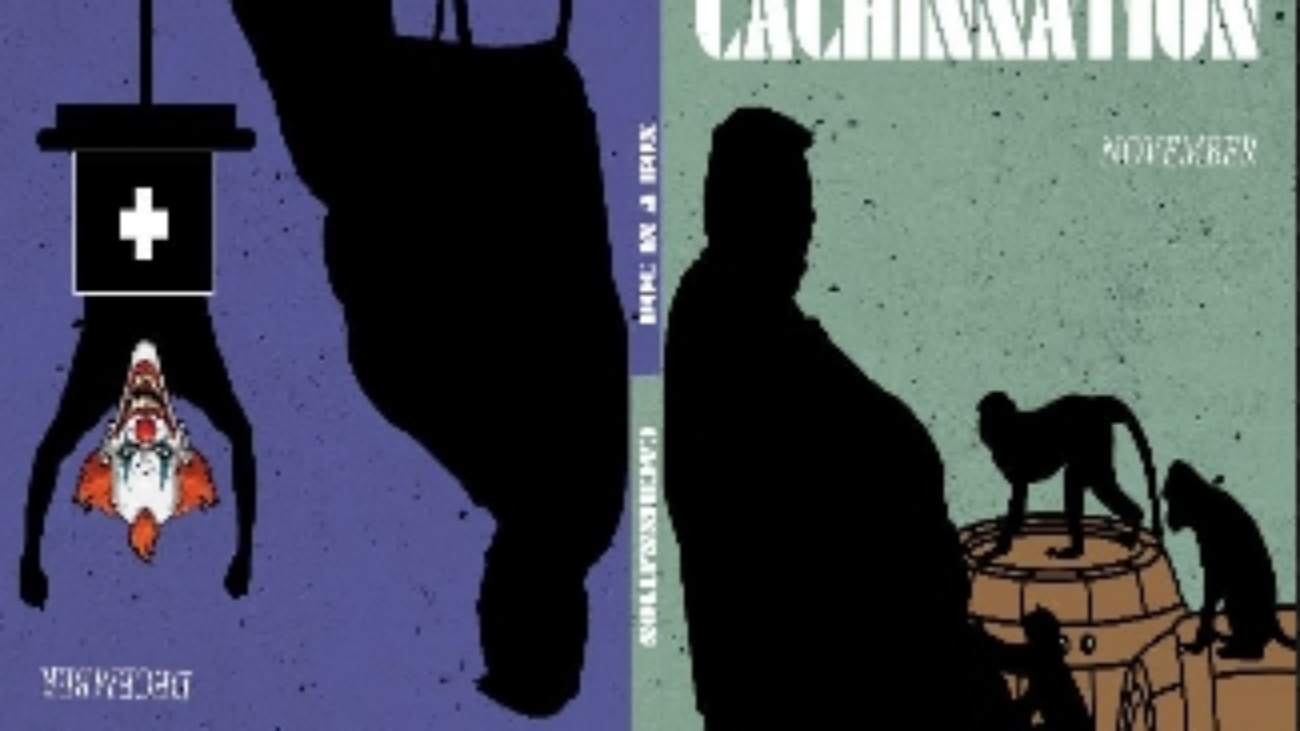
Cachinnation/Doc In A Box by William Leroy

Reviewed by Douglas R. Cobb

Two, two, two books in one! That is how I’d initially describe the two short novellas, Cachinnation and Doc In A Box , included in the prolific and talented author, William LeRoy’s, latest page-turning book. After you read Cachinnation, simply turn the book over and upside-down, and viola–there is the second novella, Doc In A Box , awaiting your engaged perusal! I thoroughly enjoyed reading both of these novellas, but I’d say, of the two, I give the edge to Doc In A Box. I would add that I definitely recommend this book to anyone who loves mystery novels combined with a generous dose of humor. I have read several of LeRoy’s novels before, and I always look forward to reading any new one he has written, and this book is no exception.  Purchase Here.

I would also recommend that  Cachinnation is read first. That’s because it covers Max Morgan’s case in the month of November, while Doc In A Box covers one in the month of December. Morgan, who is a rather corpulent man, is retired from the Postal Service and is a Notary Public who is unmarried, still lives at his mother’s house at the age of 52, and has as his office a “work station cubicle” at a local “Mister Quickie copy shop” in a small town in Oklahoma.

Morgan doesn’t have many, if any, actual friends, but he does have a lot of acquaintances, like the ones who make up a group of men who call themselves the Furries. The two members of the Furries who play the largest roles in Cachinnation are Possum McGill and Leo Wolfe, two ostensible friends who also have a mutual love interest, Possum’s wife, Lil. The two names, McGill and Lil, sort of reminded me of of a love interest in the Beatles’ song, “Rocky Raccoon,” though this might be coincidental.

Along the course of Cachinnation, Max discovers not only some dirty little secrets of some of the local townsfolk, but also learns how to laugh at himself and others. So, I would say that IMHO Cachinnation is a great start to this two novella combo, which, potential Spoiler Alert, also features a poisoned cupcake and a dead beaver.

In the second novella, Doc In A Box , it is the following month, December. Author William LeRoy’s always intrepid Max Morgan finds himself getting a bit of unwanted attention from his doctor’s wife, Candy Sanders, a “cougar,” who he believes is always on the prowl. Candy has other motives for what she does in Doc In A Box , but Morgan deduces, shall I say, otherwise.

Candy perhaps should be happy with having a doctor as her husband, but her marriage has grown from being one of convenience to inconvenience. She finds herself in an economic position where she uses her job working for her husband to get some of the doctor’s aging male clientele the prostate and ED treatment she strives to convince them that they need.

Dr. Sanders has dreams of retiring to Florida to play golf there and enjoy his retirement years, but he is retiring too early for his wife’s liking. He has not saved up enough money to satisfy her because she is several years younger than him and she wants to make sure her golden years are spent comfortably, with or without her spouse. Also, in Candy’s viewpoint, her husband’s life insurance policy wouldn’t make her golden years comfortable enough, so she doesn’t want him to retire yet.

Morgan believes Candy’s “treatment” at Dr. Sanders’ office must be because she is attracted to him and has a lustful, rather than financial, motivation for her actions. If the famous detectives he has read about in literature and their cases are any indication, Candy must be a femme fatale with murder on her mind to get her husband out of the picture, permanently. Morgan does the best he can to warn Dr. Sanders before it’s too late, and his wife does him in.
William LeRoy’s two novellas, Cachinnation and Doc In A Box, are both entertaining and page-turning reads. Mystery fans who like playful and satirical humor tales will get a kick from checking out this two-for-one Max Morgan combo by LeRoy. I also highly recommend the other novels that this prolific author has written, and I look forward to reading more of LeRoy’s books in the near future.

Authors: Get Reviewed

Readers: Latest Reviews